Britain Under Threat: Civil Defence in the Era of Total War, 1914–1989 Overview

  • Home
  • Collections
  • Britain Under Threat: Civil Defence in the Era of Total War, 1914–1989
Civil Defence Recruitment Pamphlet During The Cold War

The evolution of British Civil Defence planning, policy, and propaganda

Britain Under Threat showcases the vital role which civil defence played in the lives of the British people during the turmoil of the twentieth century
Dr Charlie Hall,
Senior Curator at BOA and Senior Lecturer in History, University of Kent.

Access the full collection

Access the full archive of Britain Under Threat: Civil Defence in the Era of Total War, 1914–1989.

Institutional Free Trial

Start your free trial 

Register for a free 30-day trial of Britain Under Threat: Civil Defence in the Era of Total War, 1914–1989, for your institution.

Institutional Sales

Visit Sales Pagesell

For more information on institutional access, visit our sales page.

Already have a license? Sign in.

Explore Civil Defence in Britain throughout the world wars and the Cold War

Poster about the Hydrogen Bomb. Sections describing what the hydrogen bomb does and what you could do feature on the left. A large photograph of Britain's nuclear test explosion features center-right, and on the far-right is a section titled what civil defense can do!
Coloured illustrations showing a civilian respirator being worn, demonstrating how to adjust and remove a civilian respirator, and showing a civilian duty respirator being worn.

One of the defining characteristics of total war is the erosion of the distinction between the home front and the frontline. During the twentieth century, when total war reached its zenith, civilians became direct targets and new technologies threatened enormous destruction, not just on the conventional battlefield but in Britain itself. As a result, an entirely new wing of government was brought into being, responsible for civil defence, and tasked with protecting Britain and its citizens from these new and terrifying threats.

Comprising over 100,000 images from hundreds of government files at The National Archives (UK), this collection explores civil defence in Britain from 1914 to 1989. This period spans the two world wars, the increasingly fraught interwar years, and the Cold War. It also covers the advent of new technologies which changed the face of warfare and which posed a particular risk to civilian lives—chemical weapons, bomber aircraft, ballistic missiles, and the atomic bomb. In responding to these dangers, civil defence took on a broad and diverse remit, encompassing everything from building air raid shelters and distributing gas masks to stockpiling medical supplies and issuing propaganda.

The files here are drawn from a number of government departments—the Home Office, the Ministry of Information, the Air Ministry, and many others—but it is not only official voices which can be heard within the sources. The responses of ordinary members of the public to the threat of attack, and to the measures put in place to protect them, come across strongly throughout. The material also reveals the true diversity of twentieth-century British society, exploring how civil defence was experienced differently along lines of social class, gender, religious identity, ethnic background, age, and disability.

As a result, this collection goes far beyond the confines of traditional military history. In fact, studying civil defence offers a unique window into many aspects of British life between 1914 and 1989. It sheds light on social dynamics, group psychology, design and mass production, concepts of home and family, public relations and propaganda, and government intervention. It likewise facilitates exploration of discourses of citizenship, fear, and other emotional responses, as well as the history of everyday life. In these ways, and in many others besides, this collection offers students and researchers a major insight into the changing social, political, cultural and ethical landscapes of modern Britain.

Contents

Britain Under Threat: Civil Defence in the Era of Total War, 1914–1989...

The evolution of British Civil Defence planning, policy, and propaganda

Discover 
Poster titled "Public Warning", featuring solid black silhouettes of German airships and aeroplanes on the left and solid black silhouettes of British airships and aeroplanes on the right.

Highlights

Section of the front page of a National Fire Brigades' Union report titled Suggestions for Fire Brigades situated in areas liable to Incendiary Attacks by Enemy Aircraft.

Licensed to access Civil defence during the First World War

The first use of poison gas in the First World War took place on the battlefields near Ypres on 22 April 1915. Just two months later, civil defence authorities in Britain were making preparations for a possible aerial gas attack on British cities, including the design of simple respirators for firefighters and guidance on treating chemical warfare casualties.
Section of the front page of the A.R.P. Guide. A crest features in the middle, with text below reading Issues by the City of Edinburgh Corporation.

Licensed to access "ARP Guide"

Not all civil defence measures were handled by central government. During the Second World War, some local authorities took matters into their own hands, as in this unofficial “ARP Guide” produced by the City of Edinburgh Corporation. To fund it, advertising space was sold to local firms, many of which used it to promote their own civil defence-related products.
Section of a front cover of an edition of The Warren Mag. No. 2. February 1941 is stamped on the page below the title. A WM crest features in the top left, and a small illustration of two trees features in the bottom right.

Licensed to access "The Warren Mag"

During the Second World War, people who sought shelter together often forged close-knit communities and, faced with long periods of boredom in between raids, took up a wide range of activities to pass the time. One example was the creation of newsletters or publications, such as this one, The Warren Mag, which contains poems, jokes, local news, and short articles.
Top half of a typed letter dated 2 June 1982. The letterhead features a crest with the text Management and Personnel Office below.

Licensed to access "Hard Rock"

During the Cold War, expectations of what a nuclear attack on Britain would look like remained speculative at best. As such, civil defence officials relied heavily on experiments and mock scenarios to test their policies. One such exercise, codenamed “Hard Rock”, was planned for 1982. It was cancelled in the face of widespread opposition from peace groups and local councils.

Insights

  • Between 1914 and 1989, warfare changed considerably. The island geography which had long kept Britain safe from marauding continental armies offered no protection against the new threat of aerial attack. Civil defence therefore became a top government priority. Moreover, the nature of the threat faced by Britain also evolved ubstantially across the 75 years covered by this collection. Military technological developments advanced at a rapid pace and the emergence of chemical weapons, long-range bombers, ballistic missiles, and the atomic and hydrogen bombs forced the civil defence establishment to continually adapt.

  • A key component of civil defence was government communication to its citizens. The public needed to understand the nature of the threat, measures they could take to minimise risk, how they would be warned of an impending attack, what to do and where to go when the warning sounded, and how they could contribute to civil defence and rescue efforts more widely. This collection explores how these communication efforts changed over time, from First World War posters, to Second World War pamphlets and propaganda films, to Cold War television adverts.

  • British civil defence in this period was not a story of unmitigated success. Captured throughout this collection are the range of criticisms levelled at various aspects of civil defence, as well as the authorities’ attempts to address them. Examples include the lack of sufficient, sanitary, and safe shelter provision at the height of the Blitz, the increase in crime and accidents caused by the blackout, the failure to get the public to take civil defence seriously, and even the view that investment in Cold War civil defence made nuclear war more likely.

  • Civil defence policy can tell us a huge amount about the social and cultural perspectives of the time in which it was formulated. For example, the widely-held belief that the working classes, and especially certain ethnic groups among them, were more likely to experience panic and develop a “mob mentality” in the face of aerial bombardment directly shaped shelter policy during the Second World War. On the other hand, many civil defence organisations actively recruited, and (eventually) offered equal pay to, women, helping to break down long-standing gender barriers.

lock_open

Unlock Historical Research for Your Institution

Provide your students and researchers with direct access to unique primary sources.

Related Media

The front cover of the Protect and Survive leaflet. Beneath the title, there is a logo of a family stood inside a hollow circle.

Britain Under Threat: "Protect and Survive" Videos

How did the government attempt to convince British citizens that a nuclear attack was survivable? Take a look at the “Protect and Survive” booklet from 1980, which was accompanied by a series of animated films Read more →
Dr Charlie Hall
Published 27th March, 2025
A document that shows a nuclear explosion, with writing overlayed that reads Civil Defence, is it any use in the nuclear age?

Britain Under Threat: Civil Defence in the Cold War Videos

The scale of the threat grew exponentially with the development of nuclear weapons. Find out how the nature of British civil defence was forced to change in the years following the Second World War. Read more →
British Online Archives (BOA)
Published 25th March, 2025
An illustration of a warden, who wears a uniform and hat, and points to the right, overlayed over an illustration of a street that is being bombed.

Britain Under Threat: Civil Defence in the Era of Total War, 1914–1989 Collection Releases

New Collection Release from British Online Archives! Britain Under Threat: Civil Defence in the Era of Total War, 1914–1989 is out now. Read more →
British Online Archives (BOA)
Published 11th March, 2025
An aged piece of paper with Air Raid Shelter written across it in capital letters.

Britain Under Threat: Civil Defence in the First World War Videos

Over the coming weeks, we will be sharing exciting insights into our new collection, Britain Under Threat: Civil Defence in the Era of Total War, 1914–1989, spotlighting important documents and the stories that they tell. Read more →
British Online Archives (BOA)
Published 12th March, 2025
A poster from the Second World War, recruiting women to join the fire service. It reads Women! You are needed in the National Fire Service as full-time of pert-time members.

Britain Under Threat: Civil Defence in the Second World War Videos

A huge civil defence endeavour was undertaken to limit the impact of aerial bombardment on Britain during the Second World War, but how did it impact the day to day lives of ordinary people? Read more →
British Online Archives (BOA)
Published 18th March, 2025
A poster from the First World War. It has a title of Public Warning, and underneath, two columns of drawings. The drawings are of German and British aircraft, which are separated under two headings written in red.

Britain Under Threat: The Use of Propaganda in the First World War Videos

We know that the British government was responsible for civil defence during the First World War, but what role did ordinary citizens play? Read more →
Dr Charlie Hall
Published 13th March, 2025
A photo of Dr Charlie Hall leafing through several documents from a file at the National Archives. The documents relate to the Bethnal Green Tube Disaster.

Britain Under Threat: The Bethnal Green Tube Disaster Videos

The Bethnal Green tube disaster was the largest loss of civilian life in the UK during the Second World War. Read more →
Dr Charlie Hall
Published 20th March, 2025

Civil Defence is Common Sense: Mobilising the Public Through Propaganda Contextual Essays

To accompany one of our latest primary source collections, Britain Under Threat: Civil Defence in the Era of Total War, 1914–1989, our Senior Curator, Dr Charlie Hall, surveys the history of civil defence propaganda in Britain. Read more →
Dr Charlie Hall
Published 13th May, 2025
Aged paper with an ornate border and a logo resembling a rainbow arch with Civil Defence written in arched text within it, along with a crown above it. The document is titled Some Things You Should Know If War Should Come. There are handwritten annotations over the page.

Document of the Week: "Some Things You Should Know If War Should Come" Document of the Week

Our latest “Document of the Week” was chosen by our Senior Curator, Dr Charlie Hall. It comprises multiple copies of the pamphlet, Some Things You Should Know If War Should Come, which was distributed throughout Britain in July 1939, when another major European conflict seemed extremely likely. Read more →
Dr Charlie Hall
Published 2nd June, 2025
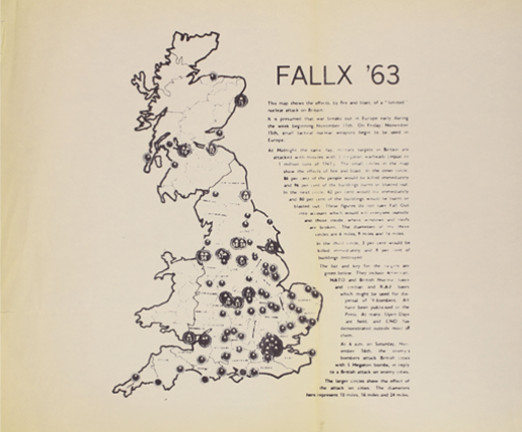
An illustration of Great Britain featuring several dots spotted across it. Text features on the right, with the title FALLX '63.

A Battleground of Facts: How Anti-nuclear Campaigners Disarmed Civil Defence Scientists in the Early Cold War Contextual Essays

In November 1963, the Campaign for Nuclear Disarmament (CND) produced a mock civil defence paper exercise to raise public awareness about government plans for nuclear attack on Britain. Read more →
Dr Jessica Douthwaite
Published 28th July, 2025
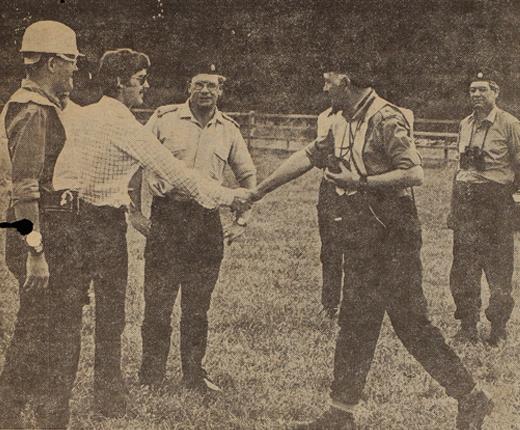
Greyscale photograph of Major Robert Manley shaking hands with a civilian pilot.

Document of the Week: "Private Armies in Great Britain" Document of the Week

Our latest “Document of the Week” was chosen by our Senior Editor, Dr Tommy Dolan. It is a letter received in August 1976 by the British Prime Minister, James Callaghan. Read more →
Dr Tommy Dolan
Published 29th September, 2025
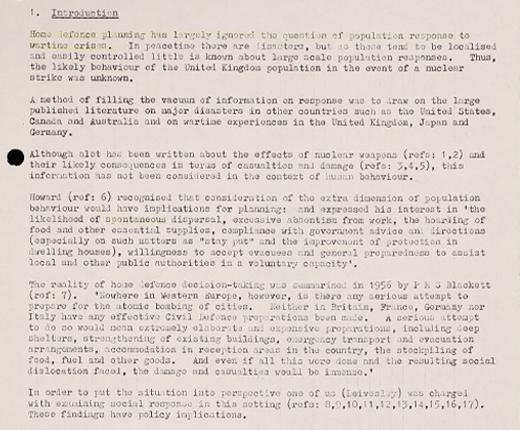
Section of a typed report.

Document of the Week: Psychological Responses to Nuclear Warfare Document of the Week

Our latest “Document of the Week” was chosen by our Senior Curator, Dr Charlie Hall. It comprises a report produced by professional risk analyst, Dr Sally Leivesley. Read more →
Dr Charlie Hall
Published 18th May, 2026
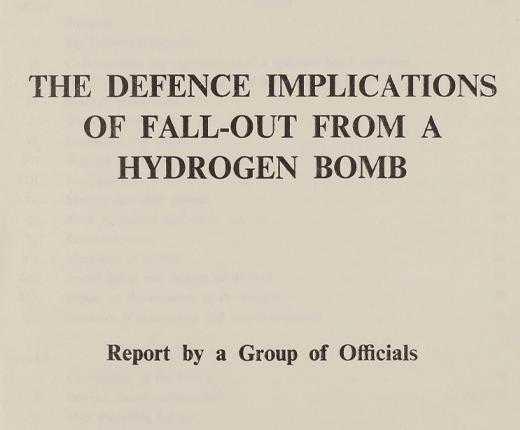
Section of the front page of a report titled The Defence Implications of Fall-Out from a Hydrogen Bomb.

“A Threat of the Utmost Gravity to our Survival as a Nation”—Planning for Thermonuclear War in Britain, 1954–1955 Contextual Essays

In this new essay, our Senior Curator, Dr Charlie Hall, examines a fascinating British government report from 1955, reflecting on both the expected experiences of thermonuclear war – “total and irretrievable collapse” – and the modest recommendations made to ameliorate its impacts. Read more →
Dr Charlie Hall
Published 12th August, 2026
Colour poster by William Little issued in 1941 showing two groups of armed marching soldiers, one from each of the countries allied to fight Germany, Japan, and Italy, facing a giant V for victory composed of the flags of each of the countries allied in the fight.

Licensed to access British Government Information and Propaganda, 1939–2009

1939   2009
British Library logo
A cover of The Illustrated War News, including an illustration of a tank, the Union Jack flag, and the French flag.

Licensed to access Illustrated War News, 1914–1918 & 1939

1914   1939
Illustrated London News logo
Representatives from the Soviet Union, UK and US at the 1945 Potsdam Conference in Potsdam, Germany.

Licensed to access Establishing the Post-War International Order, 1944–1961

1944   1961
The National Archives (UK) logo
Beige background with red and black lettering. There is a letter header to the Ministry of Information, stamped with a red SECRET stamp. Underneath it reads U.S. Secret Equals British Secret Confidential. Over the top of the image are various symbols depicting a code language.

Licensed to access Censorship: Policy and Practice During the Second World War

1914   1959
The National Archives (UK) logo
Back to Top